


 BACK TO LIVE
The best men’s hair colour for early greys is the one nobody notices. For most men in their 30s that means grey blending, not a solid block of dark dye: a soft, translucent colour that tones down the silver at the temples and crown while leaving some of it in place, so the result reads as you on a good day rather than a man who has just coloured his hair.
Grey arriving at 32 or 35 is completely normal, and it is rarely a reason to panic. It is, however, a reason to plan. The choices you make at the first appointment (how much grey to keep, which tone to use, whether to touch the beard) decide whether colour quietly sharpens your look or becomes a monthly chore with a tell-tale line at the roots. This guide walks you through those choices the way a senior colourist at Franck Provost would in a consultation.
Key Takeaways
- Grey blending softens greys by roughly half and grows out gently; full coverage is bolder and needs more frequent root work.
- Natural results come from a tone slightly lighter and cooler than your original shade, not darker.
- Hair and beard should be planned together, because beard hair takes colour differently from scalp hair.
- A skin patch test before your first colour, and before any change of product, is non-negotiable.
- Expect a refresh every four to eight weeks depending on the approach and how fast your hair grows.
Why Greys Show Up in Your 30s (and Why It’s Not a Crisis)
Hair gets its colour from pigment-producing cells at the base of each follicle. Over time those cells slow down, and each new hair grows in with less pigment until it comes through white. Seen against darker hair, white strands read as silver or grey. The timing is mostly inherited: if your father or older brothers greyed early, you probably will too. The overview of how hair loses its pigment is a useful read if you want the biology.
For Indian men, early grey often starts at the temples and sideburns, then appears as a scattering through the crown. Because Indian hair is usually very dark, even a small percentage of grey creates strong contrast, which is why a few strands can look like more than they are. That contrast, rather than the grey itself, is what most men actually want to soften.
There is also no rule that says you must colour at all. Plenty of men look sharp with a salt-and-pepper finish, especially with a precise cut and a well-shaped beard. The decision is about how you want to present yourself at work and at home, and a good consultation should help you weigh both options without pressure.
Your Men’s Hair Colour Options: Blend, Cover or Tone
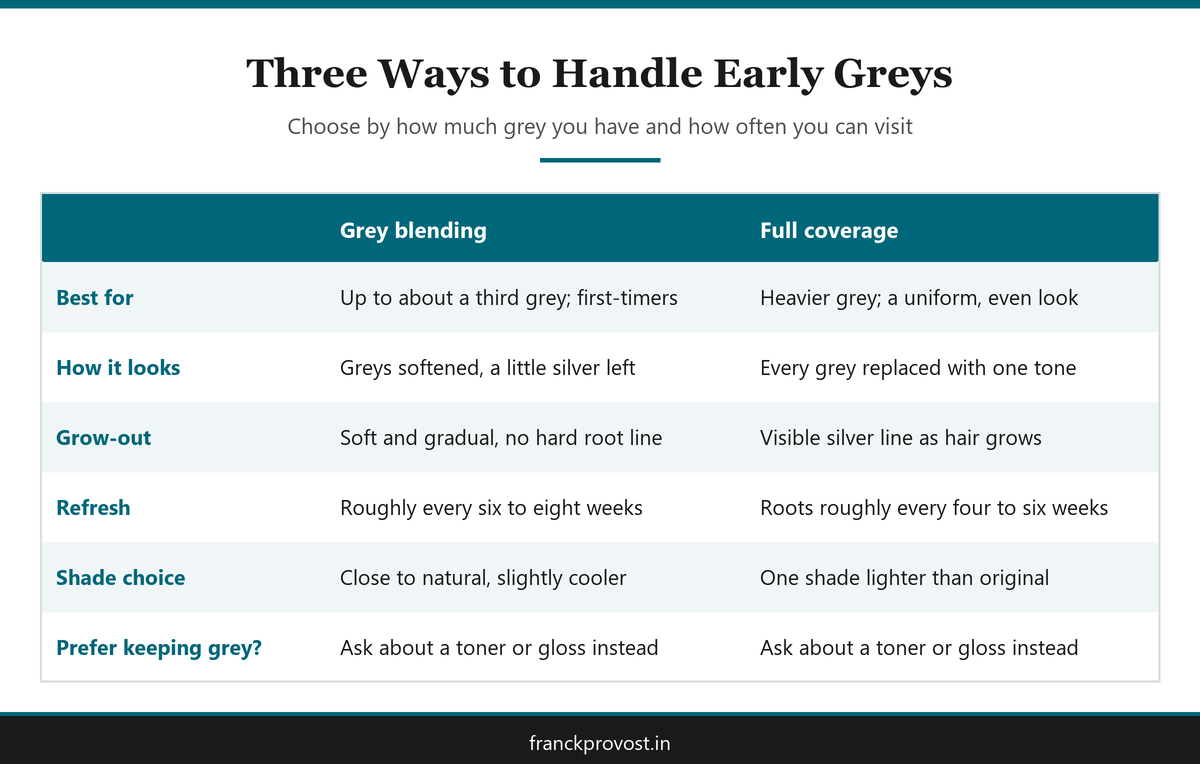
There are three broad approaches, and the right one depends on how much grey you have, how often you are willing to visit, and how visible you want the change to be.
Grey blending
A low-commitment, translucent colour that softens greys rather than hiding every strand. The grey takes on a muted, ashy tone that sits close to your natural shade, so the effect is that you look rested rather than coloured. Blending fades gradually and grows out without a sharp line, which makes it the natural starting point for men with up to roughly a third grey.
Full grey coverage
For men who prefer complete grey coverage, a permanent colour replaces every grey strand with an even tone. It suits men with heavier grey who want a uniform result, but it needs more discipline: as your hair grows, the regrowth shows as a fine silver line, so roots need regular attention.
Toning and gloss
If you are happy with your grey but dislike a yellowish cast, a toner or gloss neutralises warmth and adds shine. It is the option for the man who wants to keep his silver and make it look deliberate.
What Makes Men’s Hair Colour Look Natural
The single most common mistake, especially with box dye, is choosing a shade that is too dark. Jet-black colour on a man in his late 30s flattens the face, exaggerates any thinning at the crown, and makes regrowth look harsher. A skilled colourist will usually go one shade lighter than your original colour, and often a touch cooler, because grey hair reflects more light and a softer shade sits more convincingly beside it.
Skin tone matters as much for men as for women. Warmer complexions often look best in soft brown-blacks and neutral browns, while cooler or olive complexions can carry a cooler, ash-leaning tone. Our colourists draw on the same principles set out in our guide to choosing colour for Indian skin tones, adapted for shorter cuts where the scalp, hairline and sideburns are all on show.
Placement is the other secret. A natural result usually leaves a little more grey at the temples than the crown, because that is where real greying is most concentrated. Uniform colour from forehead to nape looks applied; a gentle gradient looks lived-in. Your cut plays a part too. A tapered back and sides makes regrowth less visible, so it is worth coordinating colour with your barber or stylist rather than treating them as separate services.
- Go lighter, not darker, than the colour you had at 25.
- Match the tone to your skin and eye colour, not to a photograph.
- Keep a hint of grey at the temples for a believable finish.
- Ask for a cut that hides regrowth between appointments.
Finally, think about how your hair will be seen. Under office lighting and on video calls, very dark colour can look almost blue-black, while a soft brown-black keeps natural depth. If you spend a lot of time outdoors, a slightly warmer tone tends to fade more gracefully in the sun. Telling your colourist where and how you spend your days helps them choose a shade that looks right in real life, not just in the salon mirror.
Don’t Forget the Beard
Many men grey in the beard before the scalp, and a dark head of hair above a silver chin can look mismatched. The reverse, a perfectly coloured head with a natural grey beard, is equally striking. The goal is harmony, not identical shades.
Beard hair is coarser and usually more resistant to colour than scalp hair, and the skin beneath it is more sensitive. That is why beard colour should be gentler and slightly lighter than the hair on your head, and why it should be applied by a professional rather than improvised in the bathroom. If you are unsure whether to colour, trim or reshape, our comparison of beard sculpting and a classic trim explains how shape alone can change how grey reads.
A well-defined beard line with a little silver often looks more distinguished than a fully darkened beard. Bring the beard into your colour consultation and decide together.
Your First Colour Appointment, Step by Step
Professional colour starts long before the brush touches your hair. The first visit is a conversation: how much grey you have, where it sits, how you style your hair, your profession and how often you can realistically come back. From there, the colourist will recommend blending, coverage or toning and explain how each will grow out.
A skin allergy test comes next. Hair dyes, including many sold for home use, can contain ingredients such as PPD that cause reactions in some people, and the NHS guidance on hair dye reactions is clear that a test should be done before each colour. If you have ever reacted to a hair or beard dye, or to a black henna tattoo, tell the salon before anything else. For a sense of how modern dyes work, the overview of permanent and semi-permanent dyes is a good primer.
If you prefer a gentler formula, ask about the ammonia-free colour options available at our salons; the colourist will advise whether they suit your level of grey.
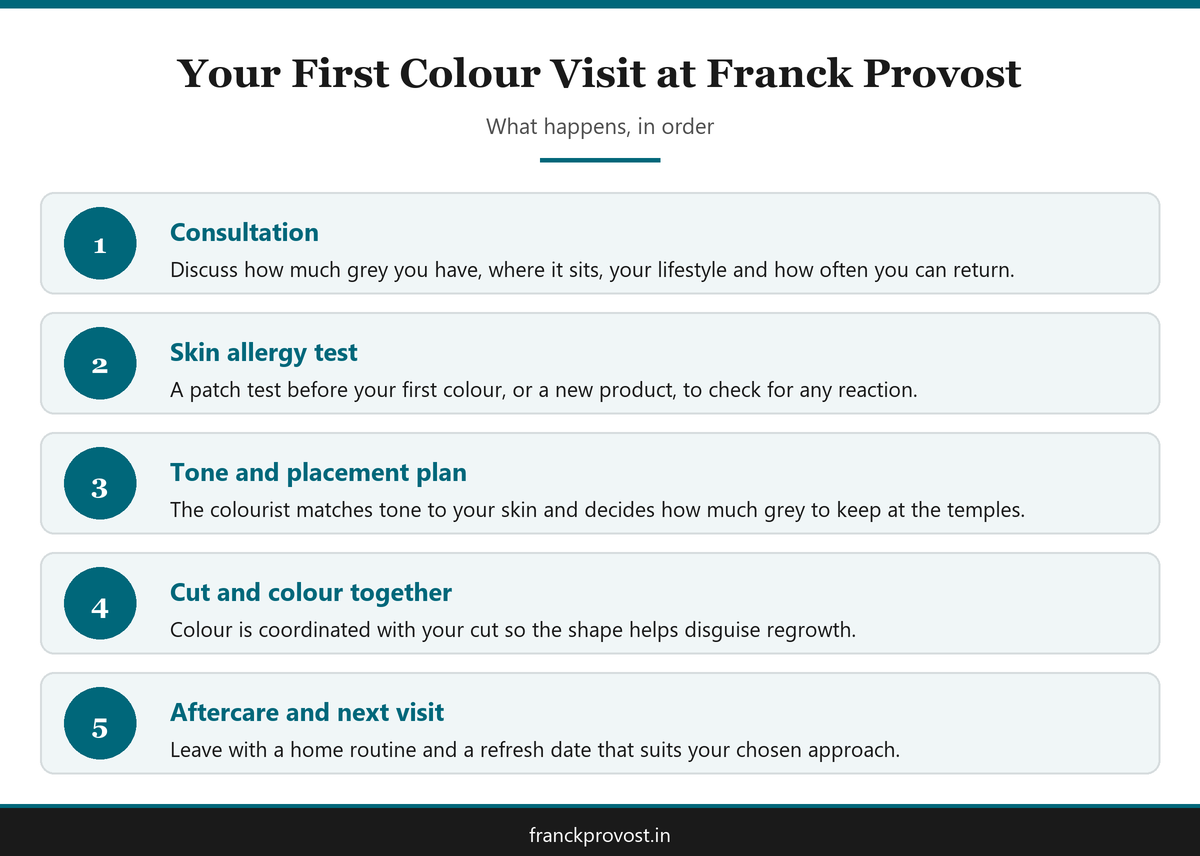
Book colour and your haircut on the same visit where you can. Cutting first and colouring second, or the reverse, depending on the technique, lets the stylist judge placement on the final shape.
Keeping Colour Natural Between Visits
Grey blending typically needs a refresh every six to eight weeks, while full coverage on short hair often needs roots done every four to six weeks. Short cuts show regrowth faster, so many men pair a colour refresh with their regular trim to keep things simple.
At home, use a colour-safe, sulphate-free shampoo and rinse with lukewarm rather than hot water. Bengaluru’s strong sun and hard borewell water both fade colour and can push it brassy, so a cap outdoors and a weekly conditioning step make a visible difference. A professional scalp ritual also helps colour sit evenly; our guide to scalp-focused hair spa for men covers what that involves.
- Wait 48 to 72 hours before the first shampoo after colour.
- Switch to a colour-safe shampoo and wash two or three times a week.
- Protect hair from midday sun and chlorinated pools.
- Book your next visit before you leave, so regrowth never catches you out.
Styling products matter more than most men expect, and the wrong one can undo good men’s hair colour. Heavy, high-shine pomades can make colour look artificial, while a matt clay or light cream gives texture that reads as natural. If you have chosen blending, resist the urge to darken the result at home between visits; topping up with a box dye is the fastest way to undo the soft finish and build up flat, dark bands that are difficult to correct later. If something bothers you, call the salon and ask for a quick tone check instead.
If your skin or scalp feels itchy, sore or swollen after any colour service, stop using the product and see a dermatologist promptly.
Conclusion
Early greys are a chapter, not a problem. Whether you choose to blend, cover, tone or keep your silver exactly as it is, the right men’s hair colour should look like nothing has been done at all, just a fresher, sharper version of you. That comes from an honest consultation, the right tone, careful placement and a cut that supports it.
At Franck Provost, colour for men sits within the wider grooming experience set out in our guide to premium men’s grooming in Bengaluru, from precision cuts to beard care. You can explore our colouring and treatment services, visit us at the Indiranagar salon in Icon Mall on +91 93640 14600, or reach HSR Layout (+91 89517 20423), Whitefield (+91 90350 72924) and Thrissur (+91 74777 79993). All salons are open 10 AM to 9 PM daily. Book your colour consultation online in a few taps and leave looking like yourself, only better.
Frequently Asked Questions
Is grey blending better than full colour for men?
For most men with up to about a third grey, yes. Grey blending softens silver strands rather than erasing them, so the result looks natural and grows out without a hard line. Full coverage suits heavier grey and a uniform look, but it needs root touch-ups more often. A colourist can show you both on your own hair during a consultation.
How often will I need to colour my hair once I start?
Grey blending usually needs refreshing every six to eight weeks, while full coverage on short hair often needs roots done every four to six weeks. Short cuts reveal regrowth faster than longer styles. Many men simply book colour alongside their regular trim so maintenance becomes part of the routine.
Will colouring my grey hair damage it?
Professional colour applied correctly causes far less stress than repeated home dyeing, because the colourist chooses the right formula and only applies it where it is needed. Gentler formulas, including ammonia-free options, are available. Using a colour-safe shampoo and regular conditioning keeps hair soft and shiny between visits.
Should I colour my beard to match my hair?
Not necessarily. The goal is harmony, not an exact match. Beard hair is coarser and takes colour differently, and the skin beneath it is more sensitive, so beard colour is usually kept gentler and slightly lighter. Some men prefer a natural grey beard with blended hair, which can look very distinguished.
Why does box dye look so obvious on men?
Box dye is usually chosen too dark and applied evenly from root to tip, which gives a flat, solid colour with no variation. Real hair has slight shifts in tone and a little more grey at the temples. A professional colourist matches tone to your skin and places colour selectively, so the finish looks natural.
Do I need a patch test before men’s grey coverage?
Yes. A skin allergy test is recommended before every colour service, especially the first one or when the product changes, because some dye ingredients can cause reactions. Tell the salon if you have ever reacted to hair dye, beard dye or a black henna tattoo. If irritation appears after colouring, see a dermatologist.
Where can I get hair colour for men in Bangalore?
Franck Provost offers men’s colour, from grey blending to full coverage and toning, at its Indiranagar, HSR Layout and Whitefield salons in Bengaluru and at Aswini Junction in Thrissur. Every service starts with a consultation. You can book online through the Zenoti store or call your nearest salon; all are open 10 AM to 9 PM daily.